
Introducing a New Horse: How to Blend Mixed-Age Herds Without Conflict
On September 15, 2026 by lukasRethinking Pasture Introductions for Modern Mixed Herds
Turning an unfamiliar horse loose with an established herd and expecting the animals to “sort it out” is an outdated management shortcut. Horses may need to establish boundaries, but an uncontrolled first meeting can produce severe chasing, cornering, bites, double-barrel kicks, fencing accidents, and injuries that continue to affect confidence long after the visible conflict has ended. A safer approach is to plan the introduction as a gradual change in social conditions, not as a single event.
Mixed-age herds require particular care because age, physical ability, temperament, and social experience rarely match. A young horse may misread a warning from an older horse and continue pressing for interaction. A senior horse with arthritis, reduced hearing, or limited vision may be slower to move away. Horses that have spent much of their lives in individual turnout may also lack the conflict-resolution skills developed through stable, well-managed group living. Implementing careful herd management protocols alongside sound stable safety measures ensures smoother transitions for newcomers.
Horse-first management uses three principles: allow decompression before demanding social contact, expose horses in controlled stages, and arrange the environment so no individual is trapped beside food, water, gates, or fencing. The goal is not to eliminate every squeal or pinned ear. The goal is to prevent panic and sustained persecution while giving the horses enough time, space, and information to establish a durable social balance.
- Complete health and biosecurity checks before social contact.
- Begin with sight, scent, and sound through a safe barrier.
- Progress only when horses can eat, rest, and move calmly near one another.
- Design turnout areas with multiple escape routes and distributed resources.
The Equine Stress Response and Silent Agonistic Signals
A new horse changes the social structure of an established herd. Even when no serious fight occurs, the newcomer and resident horses may experience acute social stress, increased vigilance, and elevated autonomic arousal. Cortisol and other stress responses can narrow attention, reduce flexibility, and make a horse more reactive to movement or pressure. A horse that appears merely “fresh” may therefore be operating with reduced decision-making capacity, especially in a confined or unfamiliar paddock.
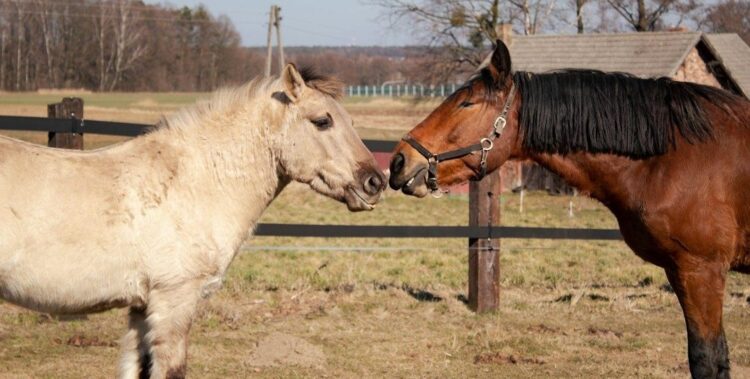
Visible aggression is only one part of the assessment. Watch for displacement behaviours such as repeated pawing, aimless pacing, excessive manure-scenting, abrupt turning away, fence-running, or persistent agitation around a gate. Subtle agonistic signals may include a triangular wrinkle around the eye, a tightened muzzle, compressed lips, a raised neck, a shortened stride, or a small shift of the hindquarters toward another horse. These micro-postural changes often provide an earlier warning than a bite or kick. Guidance from World Horse Welfare similarly emphasizes gradual exposure, close observation, and sufficient space to reduce conflict during a normal but stressful social adjustment.
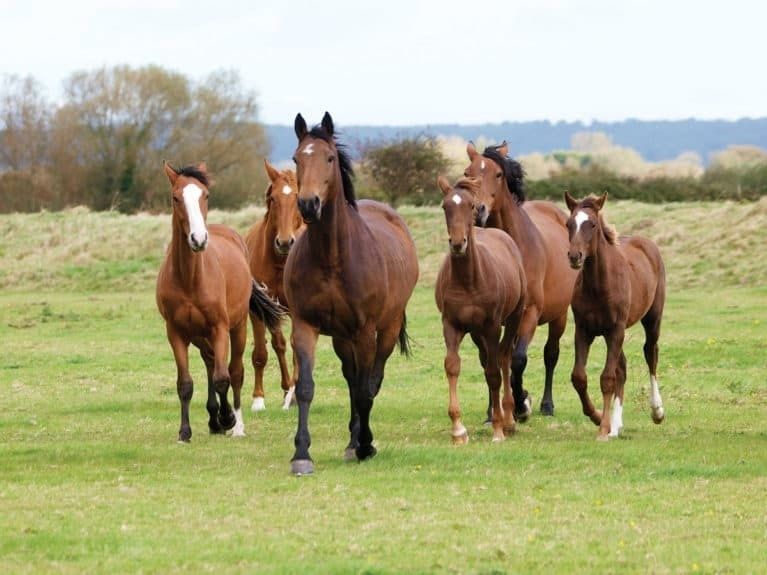
Equally important are the signs that psychological safety is developing. Horses that begin grazing in the same area, lower their heads while standing near each other, rest one hind leg, walk without repeatedly checking the other horse, or stand parallel with loose necks are showing more than physical tolerance. These affiliative micro-signals indicate that arousal is falling. Record what happens before and after each interaction rather than judging the introduction only by its loudest moment.
| Observed behaviour | Likely meaning | Management response |
|---|---|---|
| Brief squeal followed by grazing | Normal assessment with recovery | Continue observation if space and footing are safe |
| Repeated chasing or cornering | Escalating social pressure | Separate and return to an earlier phase |
| Relaxed head drops and parallel standing | Emerging comfort | Maintain the routine and avoid rushing the next step |
| Panic, fence-running, or refusal to eat | Excessive distress | Increase distance and seek veterinary or behavioural advice |
Designing the Safe Perimeter with Shared Fence-Line Protocol
Biosecurity comes before introductions. The newcomer should complete the yard”s isolation, veterinary, vaccination, parasite-control, and health-screening requirements before sharing airspace or equipment with resident horses. The exact procedure depends on local disease risks and veterinary advice, but the principle is consistent: do not use social integration to discover an infectious problem. During this period, handlers can assess appetite, manure, soundness, hydration, and baseline behaviour without the added pressure of a new herd.
The first social step should normally be a secure fence-line arrangement. A double-fenced lane or parallel paddock allows horses to see, smell, and hear one another while preventing direct bites and kicks. The gap must be wide enough that legs cannot become trapped and should have no barbed wire, sharp projections, hazardous openings, or narrow corners. Good footing and clear visibility matter. A horse should be able to move away from the boundary without being forced into a gate, wall, muddy patch, or dead end.
Fence-line contact may last a day or two, or considerably longer for anxious, inexperienced, or highly reactive horses. Calm eating on opposite sides of the boundary is useful evidence because appetite often disappears when arousal is too high. Scent exchange, including carefully managed movement of droppings between areas, can also provide information before physical contact. Progress when the horses repeatedly recover after normal communication, not simply because a certain number of hours has passed.
- Place hay well away from the fence so horses are not forced into close competition.
- Provide at least two routes away from the shared boundary.
- Inspect every rail, mesh opening, gate, and post before the horses arrive.
- Keep experienced handlers present during the first close interactions.
- Use breakaway equipment where appropriate and avoid leaving unsafe halters on turnout horses.
Protecting Vulnerable Demographics in Mixed-Age Fields
Senior horses often need more room and more time than their younger companions. Arthritis can make rapid acceleration, sharp turns, and slippery footing painful. Reduced hearing or vision may delay a response to an approaching horse, while dental limitations can make it harder to maintain condition when access to forage is interrupted. A horse that cannot move away comfortably may become defensive, not because it is generally aggressive, but because its options are restricted.
Young horses have a different vulnerability. A youngster with limited herd literacy may approach too directly, play too roughly, or ignore early warnings because the signals are unfamiliar. Such horses benefit from a socially skilled, tolerant adult rather than a group dominated by equally inexperienced or excitable peers. The best companion is not necessarily the highest-ranking horse. Calm confidence, clear boundaries, and the ability to disengage after a correction are more valuable than status alone.
Pasture design can reduce the physical consequences of ordinary social negotiation. Use wide gates, avoid narrow passages, maintain dry escape lanes, and create calm zones where a horse can stand without being pressed against a fence. Visual divisions such as hedges or safe screens may help break direct line-of-sight pressure, provided they do not create hidden corners. Older horses should be monitored for reduced eating time, weight loss, stiffness, or isolation, while young horses should be watched for exhaustion, repeated harassment, or inability to rest.
- Provide broad, non-bottleneck entrances and exits.
- Repair mud-prone areas before turnout, especially near gates and water.
- Keep sheltered or quiet standing areas accessible from more than one direction.
- Give senior horses additional forage opportunities and monitor body condition.
- Interrupt play or pursuit when a vulnerable horse cannot disengage safely.
A Tactical Four-Phase Protocol for Physical Integration
Physical integration should be treated as a series of decisions. The timing may vary with the horses, weather, footing, pasture size, and staffing. If a horse shows persistent distress, repeated chasing, or dangerous escalation, separate the animals without punishment and return to a stage where calm behaviour is possible.
- Phase 1, controlled buddy pairing. Select a calm, socially competent resident and introduce the newcomer in a neutral, spacious turnout area. Avoid a valuable feeding station or the resident”s usual resting site. Turnout is safer when both horses have eaten and drunk, the footing is sound, visibility is good, and handlers can observe without entering an active conflict. Brief squeals, sniffing, posturing, or a warning kick may occur, but repeated pursuit, cornering, biting, or panic requires separation.
- Phase 2, gradual group expansion. Once the pair can graze, walk, rest, and disengage without sustained pressure, add passive herd members one at a time or in a small, carefully chosen group. This reduces the number of new relationships being negotiated simultaneously. Allow the original pair to retain access to open space rather than placing them into a crowded holding area.
- Phase 3, primary-field turnout. Move the developing group into the main field during calm daylight hours, preferably when staff are available and distractions are minimal. The resident group should not be waiting tightly around a gate, hay ring, or waterer. Remove avoidable hazards, distribute forage widely, and give the newcomers a clear route through the field. If practical, temporarily separating a highly antagonistic resident can lower pressure while the new horse establishes safer relationships.
- Phase 4, structured observation. The first release is only the beginning. Observe the initial period closely, then check the group at regular intervals for several days. Assess whether horses are spreading naturally, sharing space without constant vigilance, lying down or resting, eating adequately, and returning to normal movement. Social stability may require weeks or months, even after obvious aggression has diminished. Maintain a written record of chasing, injuries, appetite, resting patterns, and changes in body condition.
Turnout decisions should never be based on the absence of a kick during the first hour. A horse can be quietly excluded from forage or driven away from water without a dramatic confrontation. Look at the whole day. Does the newcomer have uninterrupted access to resources? Can the older horse lie down? Does the youngster ever stop moving? Are pairs forming that leave one horse consistently isolated? These answers reveal whether the herd is settling or merely suppressing visible conflict.
Eliminating Forage and Water Resource Guarding
Food and water turn ordinary social tension into a practical safety problem. A useful starting rule for forage stations is N+2, meaning at least two more feeding locations than there are horses, distributed across a broad area. The piles should be separated far enough that one dominant horse cannot control several stations at once. Small, widely spaced piles often work better than one large ring because they allow lower-ranking horses to leave and return without crossing a guarded bottleneck.
Water points deserve the same scrutiny. Automatic waterers, troughs, and hay rings should not sit in corners or against a solid fence where a subordinate horse can be trapped. Provide multiple access routes and consider more than one water source for larger groups. Inspect the ground around each station, since deep mud can make an escape route unusable. The aim is not merely to add resources, but to distribute them so that horses can choose distance.
Hard keepers and horses with special feeding needs require separate planning. A senior or thin horse may need individual meals, soaked feed, or additional forage, but feeding that horse beside the herd can provoke resource defence. Use a secure, calm feeding area with visual separation, then return the horse only when the meal is complete and the group is settled. Monitor weight, manure, appetite, and eating time, and involve a veterinarian or equine nutrition professional when condition changes cannot be explained by ordinary management. Resource distribution should support the vulnerable horse without creating a predictable confrontation point.
- Use at least two more forage stations than the number of horses whenever practical.
- Separate hay, water, gates, and resting areas rather than clustering them together.
- Remove empty hay rings or equipment that narrows movement routes.
- Feed special diets separately and keep the process predictable.
- Reassess resource placement after rain, pasture changes, or a shift in herd membership.
Build Long-Term Herd Harmony Through Predictable Management
True integration is measured in weeks of calm coexistence, not in a few hours without kicking. Early aggression may reduce within several days to two weeks, but the social structure can continue changing for much longer. A horse that has learned where it can graze, rest, drink, and retreat is more likely to remain settled than one that was simply left in a field until the noise stopped.
Consistent routines, adequate space, sound footing, distributed resources, and vigilant observation protect every resident, from the newest youngster to the oldest horse in the yard. Management shapes behaviour. Small adjustments, such as moving a water trough away from a gate or adding one quiet adult companion, can prevent a serious conflict. Patience during onboarding preserves pasture soundness, reduces avoidable injury, and gives the herd the best chance to develop lasting social resilience.